Bible Study: Acts-Week 8: The Epic Impact of Corinth and Ephesus
Updated: Jun 24

Welcome to Week 8 of our study through the Book of Acts. Last week, we followed Paul through the "Trials and Triumphs" of Macedonia, watching a midnight prison cell fill with praise and tracking his intellectual bridge-building with the philosophers of Athens.
This week, we dive into Chapters 18 and 19, a major shift in the timeline of the early church. Moving away from quick stops and sudden scatterings, we find Paul settling in for "The Long Haul." We will explore his extended stays in two of the most influential, wealthy, and highly idolatrous cities in Greece and Asia Minor: Corinth and Ephesus.
Acts 18 Summary: Paul’s 18-Month Ministry in Corinth
Athens and Corinth were the dual cultural powerhouses of Greece, but they couldn't have been more different. Corinth was world-famous for its biennial athletic games. Unfortunately, it was equally famous for staggering immorality. The city housed a massive temple to Aphrodite that employed as many as 1,000 shrine prostitutes; in fact, the term "Corinthian woman" was ancient slang for a prostitute.
Yet, this is the exact place where Paul would anchor down for 18 months. This would be the his longest recorded stay in a single location up to this point in Acts.
Aquila, Priscilla, and the Power of Providence
In Corinth, Paul meets Aquila and Priscilla, a Jewish couple who had been forced out of Rome by a decree from Emperor Claudius.
The Lesson of Providence: It’s incredible to watch the mission of Acts expand here. In previous chapters, persecution scattered the believers outward. Now, God uses a pagan emperor's decree to send crucial, Gospel-bearing partners straight to Paul.
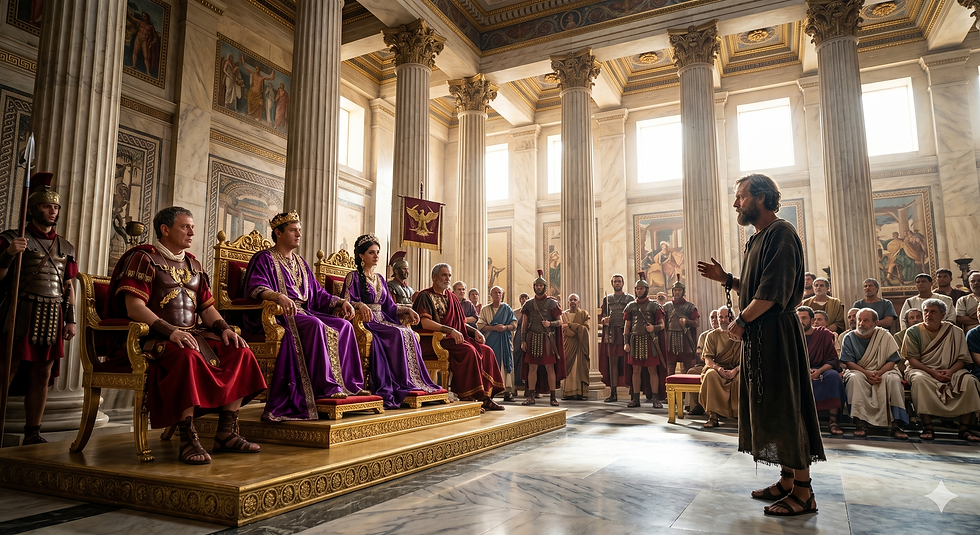
When the local Jewish leaders reject his teaching, Paul receives a reassuring vision from God telling him to keep speaking boldly. When the disgruntled leaders drag him before the Roman proconsul, the official completely dismisses the crowd.
The mob turns its rage on Sosthenes, the ruler of the synagogue, beating him in public. This detail adds amazing backstory to our New Testament: Paul eventually mends things with Sosthenes, listing him as a co-writer and scribe in 1 Corinthians.
Who Was Apollos in the Bible? (Acts 18:24-28)
Before moving into Chapter 19, Luke introduces us to an eloquent Jewish man named Apollos. He arrived in Ephesus on fire for the Lord and highly instructed in the scriptures, though he only knew of John's baptism.
Priscilla and Aquila took him aside to explain the Way of God more accurately. Demonstrating a teachable heart, Apollos accepted their leadership and went on to Corinth. He became a major figure in the early church, so much so that Paul later addressed divisions in Corinth by describing himself as the one who "planted" the church and Apollos as the one who "watered" it.
Acts 19: The Seven Sons of Sceva and the Occult in Ephesus
In Chapter 19, Paul arrives in Ephesus for a ministry that would last over two years. This would be his longest stay recorded in the entire Book of Acts. He speaks boldly in the synagogue for three months before transitioning to the Hall of Tyrannus, spreading the Gospel across the entire province of Asia Minor.
Ephesus was a notorious hotbed for witchcraft, sorcery, and the dark arts. But the sheer power of the Gospel completely overwhelmed these lesser practices. After a failed, fraudulent exorcism by the seven sons of Sceva, a holy fear gripped the city. Believers openly confessed their magic practices and brought their sorcery scrolls together for a massive bonfire.
The total value of the burned occult books? 50,000 pieces of silver! As Acts 19:20 declares: "So the word of the Lord continued to increase and prevail".
The Riot of the Silversmiths
True revival always disrupts the pocketbooks of a corrupt culture. The massive spiritual shift in Ephesus completely tanked the local idol-making economy. A local silversmith named Demetrius, who made a great income crafting silver shrines of the goddess Artemis, grew desperate. He rallied his fellow craftsmen by arguing that Paul’s message, that gods made by human hands are no gods at all (Acts 19:26, Isaiah 37:19, 2 Kings 19:18, Jeremiah 16:20), was ruining their business and discrediting their temple.
The Temple of Artemis
The Temple of Artemis was no small neighborhood church; it was one of the Seven Wonders of the Ancient World and the largest structure in the Roman Empire. Demetrius’s speech successfully stirred the crowd into a blind frenzy. They dragged Paul’s companions into the massive city stadium, resulting in total chaos. Luke notes with a touch of irony that many of the rioters didn't even know why they were there. They simply spent two straight hours shouting in an uproar: "Great is Artemis of the Ephesians!".
Ultimately, the city town clerk restored order by reminding the crowd that the courts were open for legal assemblies, and that they risked being charged with rioting by Rome if they didn't calm down.
Practical Life Applications from Acts 18 and 19
What stood out to you this week? Is it the image of a culture burning 50,000 pieces of silver worth of past sins to follow Jesus? Or is it the reminder that gods made by human hands cannot even step down from their pedestals to defend themselves?
Final Thought: Paul stayed in the mess of Corinth and Ephesus for years because he knew that deep roots require time.
Join us next week for Week 9 as we look forward to Acts 20 through 22, where Paul gives a tearful goodbye to the Ephesian elders and prepares to face the chains waiting for him in Jerusalem!



Comments