Bible Study: Acts Week 11- To Caesar You Shall Go!

Bible Study
Welcome to Week 11 of our Bible Study through the Book of Acts. This week, we bring our incredible journey to a close as we cover Chapters 26 through 28.
Last week, we watched Paul use his legal standing as a Roman citizen to bypass a corrupt political trap and boldly declare, "I appeal to Caesar!" This week, we see the absolute climax of that appeal. We will listen in as Paul delivers a masterclass in logic to pagan royalty, survive an apocalyptic autumn hurricane in the Mediterranean, and finally watch the wildfire of the Gospel ignite the very heart of the Roman Empire.
A Masterclass in Logic Before King Agrippa II
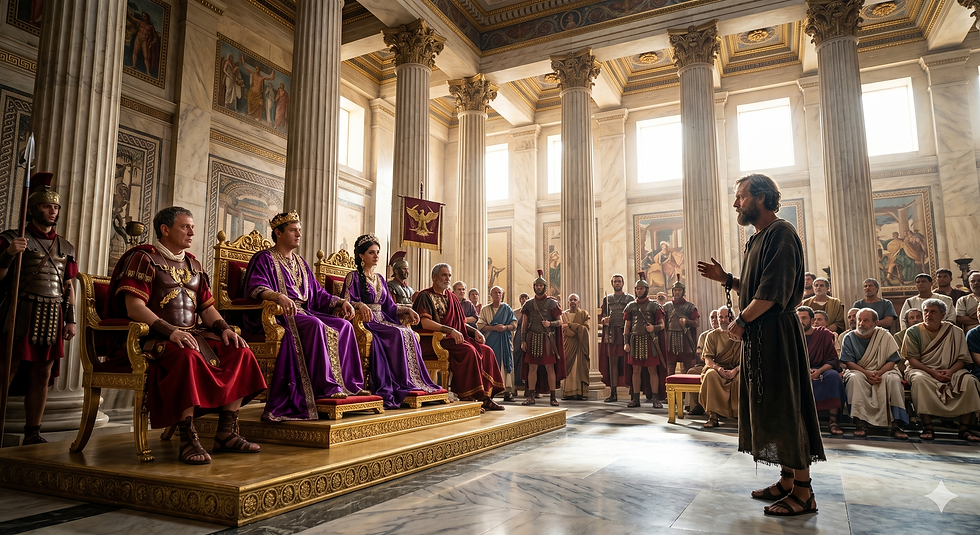
Chapter 26 opens with Paul standing before the final proxy ruler of the Herodian Dynasty, King Agrippa II. Paul begins his defense by anchoring his entire life to a singular theme: Hope.
Luke highlights this specific repetition in the text:
Acts 26:6–7 (ESV)
"And now I stand here on trial because of my hope in the promise made by God to our fathers, to which our twelve tribes hope to attain, as they earnestly worship night and day. And for this hope I am accused by Jews, O king!"
"And now I stand here on trial because of my hope in the promise..." (Verse 6)
"...to which our twelve tribes hope to attain..." (Verse 7)
"...And for this hope I am accused..." (Verse 7)
The Fulfillment of the Promise: The "promise" Paul emphasizes is the long-awaited Messiah and Savior—the ultimate promise made to Abraham that through his seed, all the tribes of the earth would be blessed.
Paul retells his dramatic conversion story, defining his explicit mission from Jesus: to open the eyes of the people, turn them from darkness to light, offer them the forgiveness of sins, and show them how to be sanctified through faith.
Acts 26:17–18 (ESV)
"...delivering you from your people and from the Gentiles—to whom I am sending you to open their eyes, so that they may turn from darkness to light and from the power of Satan to God, that they may receive forgiveness of sins and a place among those who are sanctified by faith in me."
When Governor Festus cuts in, loudly shouting that Paul's great learning is driving him mad, Paul disarms the emotional outburst with pure elegance. He declares that his words are "true and rational," choosing to appeal to logos (logic and public facts) rather than raw emotion. He points out that these monumental events were not done in a hidden corner.
Paul presses King Agrippa so closely that the king famously responds,
Acts 26:29 (ESV)
"And Paul said, 'Whether short or long, I would to God that not only you but also all who hear me this day might become such as I am—except for these chains.'"
Paul replies with profound grace, wishing that everyone listening might become exactly as he is—except for his chains. Once again, the royal court concludes that Paul has done absolutely nothing deserving of death or imprisonment.
The Graveyard of the Mediterranean
In Chapter 27, Paul is placed on a ship bound for Italy under Roman guard, accompanied by Luke (noted by the return of the first-person "we" statements).
By the time they cross the south coast of Asia Minor and reach Fair Havens on the island of Crete, it is already mid-October—explicitly marked by Luke noting that "the Fast" (the Day of Atonement) had already passed. Paul warns the centurion that continuing the voyage at this time of year will result in a catastrophic loss of cargo, ship, and human life. However, the centurion listens to the ship's pilot and owner instead, attempting to make a short 40-mile run to a better winter harbor.
Fourteen Days in the Abyss
They are instantly caught by a "Northeaster"—a hurricane-force tempest that violently sweeps them out into the open sea. For fourteen terrifying days, the ship is aimlessly pounded by waves in the middle of the Adriatic Sea. They throw the cargo and the ship's tackle overboard, completely losing sight of the sun or stars.
Amid the total despair of the crew, Paul steps forward with a message of reassurance from an angel of God: the ship will be destroyed, but not a single life will be lost.
Just before dawn on the fourteenth night, as they near land, Paul urges the exhausted crew to take some food. He performs a deeply theological and ritual action: he takes bread, gives thanks to God in the presence of everyone, breaks it, and begins to eat.
Acts 27:35–36 (ESV)
"And when he had said these things, he took bread, and giving thanks to God in the presence of all he broke it and began to eat. Then they all were encouraged and ate some food themselves."
This profound act of worship in the middle of a life-threatening crisis completely shifts the atmosphere, encouraging all 276 terrified souls on board.
The next morning, they attempt to run the vessel aground, but the ship strikes a reef and is violently smashed to pieces by the surf. Just as God promised, every single person safely makes it to the shore of a small island called Malta.
Rome: An Unhindered Kingdom
After wintering in Malta for three months, Paul finally arrives in Rome. True to his lifelong custom, he immediately calls for the local leaders of the Jews.
Paul spends an intensive day running from morning until evening, explaining the kingdom of God and trying to convince them about Jesus from the Law of Moses and the Prophets. When some refuse to believe, Paul delivers a parting warning by quoting Isaiah 6:9-10.
Acts 28:26–27 (ESV)
"'Go to this people, and say: "You will indeed hear but never understand, and you will indeed see but never perceive." For this people's heart has grown dull, and with their ears they can barely hear, and their eyes they have closed; lest they should see with their eyes and hear with their ears and understand with their heart and turn, and I should heal them.'"
This is the exact same passage Jesus used in Matthew 13 and Mark 4 to explain the Parable of the Sower, highlighting a tragic reality: their hearts had grown dull, resulting in a deep spiritual insensitivity.
The Book of Acts ends with a striking image of Paul living in Rome for two full years under house arrest at his own expense. While in those chains, he actively penned what we now call the Prison Epistles, writing timeless truths to the churches:
Ephesians 2:1-9: Reminding us that God is rich in mercy and that we are saved strictly by grace through faith.
Philippians 1:19-26: Declaring with absolute conviction that "to live is Christ, and to die is gain."
Colossians 3:1-17: Exhorting believers to set their minds on things above and let the peace of Christ rule in their hearts.
Bible Study: Reflect and Close
We have officially completed our 11-week journey through the Book of Acts! From a small room of 120 praying believers in Jerusalem to an unhindered gospel fire burning in the capital of the Roman Empire, we have seen that the growth of the church occurs in the very teeth of opposition.
Paul endured relentless persecution—mobs, stonings, beatings, multiple imprisonments, a two-week hurricane, a shipwreck, and even a venomous viper bite—yet he counted all his past worldly gains as total loss for the sake of knowing Jesus Christ (Philippians 3:7-9). What makes his legacy so remarkable is his posture toward suffering; he consistently chose to rejoice, protect unity, and stand completely firm.
Knowing these historical backstories, characters, and settings does so much to aid in our appreciation that these events really happened. But it also deepens our appreciation for our spiritual heritage and equips us to boldly share the Gospel, endure when opposition inevitably comes, and live completely unashamed of the name of Jesus!
A Closing Prayer for Our Study
Lord, thank you for your living Word. Help us move from merely holding good doctrine to living fully, righteously, and powerfully. Help us to set our minds on things above. Grant us the grace to walk daily in kindness, humility, meekness, and patience. Jesus, may Your supernatural peace rule our hearts, may Your message dwell in us richly, and may our lives always overflow with thanksgiving. Let us not be ashamed of the Gospel and declare it as boldly and as often as Paul did!
We freely submit our will and our ways to Your perfect will and way. In the mighty name of Jesus, Amen!


Comments