Bible Study: Acts Week 10- Gospel before Courts and Kings: The Strategy of Sovereignty
Welcome to Week 10 of our Bible Study through the Book of Acts. Last week, we followed Paul's emotional march to Jerusalem, where an outraged temple mob dragged him into the streets before a Roman tribune intercepted the chaos.
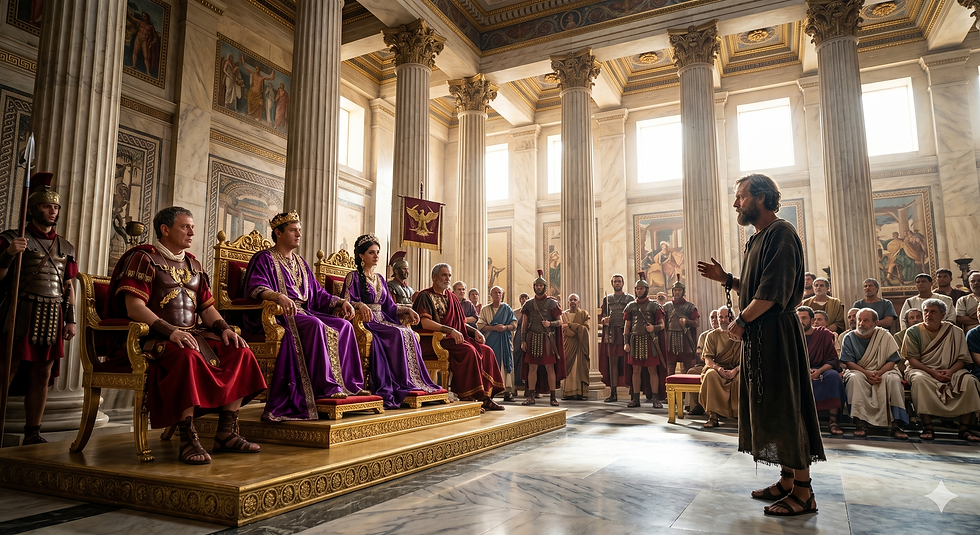
This week, we cover Chapters 23 through 25, stepping into a high-stakes legal drama. As the title "Gospel before Courts and Kings" suggests, we see Paul's active missionary traveling put on pause as he transitions into a strategic courtroom witness. Through it all, we watch Roman law, crooked politicians, and a failed hunger strike inadvertently push Paul toward his ultimate destination: Rome.
Fracturing the Sanhedrin
Chapter 23 opens with the Roman tribune calling a meeting of the Jewish high council (the Sanhedrin) to uncover the exact charges against Paul. When Paul asserts his innocence, the high priest Ananias immediately commands that Paul be struck on the mouth.
"And the high priest Ananias commanded those who stood by him to strike him on the mouth. Then Paul said to him, 'God is going to strike you, you whitewashed wall! Are you sitting to judge me according to the law, and yet contrary to the law you order me to be struck?'"
The Broken Law: This command directly violated Levitical and Deuteronomic law (Leviticus 19:15, Deuteronomy 25:1-2), which stated that an accused person could only be punished after being legally proven guilty. No evidence had even been presented.
Paul sharply reacts, calling Ananias a "whitewashed wall," but when informed that he was addressing the high priest, Paul immediately demonstrates humility, acknowledging his mistake and defusing his tone.
Historical accounts by Josephus support this backstory, describing Ananias as an insolent, quick-tempered ruler. Appointed in 47 AD, he was dismissed around 58–59 AD—within a year or two of this exact trial—and was later assassinated by Jewish guerrillas in 66 AD.
The Resurrection Pivot
Recognizing that the room is a mix of Sadducees and Pharisees, Paul makes a brilliant tactical move.
Acts 23:6 (ESV)
"Now, when Paul perceived that one part were Sadducees and the other Pharisees, he cried out in the council, 'Brothers, I am a Pharisee, a son of Pharisees. It is with respect to the hope and the resurrection of the dead that I am on trial.'"
He stands up and declares that he is on trial for his belief in the resurrection of the dead.
The Sadducees flatly denied the supernatural, angels, and the afterlife.
The Pharisees fiercely defended the reality of the resurrection.
Instantly, the theological fault lines in the room rupture. The council completely unravels into an uproar, with the Pharisees suddenly defending Paul. The debate becomes so violent that the Roman tribune has to step in and forcefully extract Paul to protect his life.
A Failed Hunger Oath and a Midnight Escort
Frustrated by their failure in court, a radical faction of more than 40 men form a secret conspiracy to ambush and assassinate Paul. They bind themselves to an extreme oath: not to eat or drink anything until they have murdered him.
Fortunately, Paul's nephew overhears the plot and leaks it to the tribune, Claudius Lysias. Taking the threat seriously, Lysias determines that Paul has done nothing deserving of death or imprisonment under Roman law. To keep a Roman citizen safe, the tribune orders an emergency midnight military escort to transfer Paul out of Jerusalem to Governor Felix in Caesarea.
Courting the Governor: The Case Before Felix
Five days later, the high priest and a smooth-talking lawyer named Tertullus arrive in Caesarea to prosecute Paul. Tertullus opens with heavy flattery to get on Governor Felix's good side before laying out three main accusations:
Paul is a public nuisance who stirs up riots among Jews worldwide.
He is a ringleader of an illegal, unrecognized sect (the Nazarenes).
He attempted to profane the temple by bringing a Gentile into forbidden areas.
When given the floor, Paul directly refutes the charges:
Acts 24:11–13 (ESV)
"You can easily verify that no more than twelve days ago I went up to Jerusalem to worship. My accusers did not find me arguing with anyone at the temple, or stirring up a crowd in the synagogues or anywhere else in the city. And they cannot prove to you the charges they now make against me."
Paul proudly admits to being a follower of "the Way," pointing out that his faith aligns entirely with the Hebrew scriptures, the law, and the prophets—anchored entirely by his hope in the resurrection. Felix, unwilling to upset the Jewish leadership, leaves Paul under a loose house arrest in Caesarea for two full years.
Appealing to the Ultimate Court
When Governor Festus replaces Felix, the Jerusalem leadership immediately tries to revive the assassination plot, asking Festus to transfer Paul back to Jerusalem for trial. Festus convenes a tribunal in Caesarea to settle the matter.
Sensing a corrupt political trap, Paul utilizes his ultimate legal right as a Roman citizen and declares: "I appeal to Caesar!"
Acts 25:11 (ESV)
"If then I am a wrongdoer and have committed anything for which I deserve to die, I do not seek to escape death. But if there is nothing to their charges against me, no one can give me up to them. I appeal to Caesar.
Why appeal to Rome? Paul knew he could not get a fair, substantiated trial in Jerusalem. More importantly, Paul was acting on a divine directive. Back in Acts 23:11, Jesus had personally appeared to Paul in a vision, telling him to take courage because he was destined to testify in Rome. The appeal to Caesar was the physical mechanism bringing God's spiritual plan to pass. You can easily verify that no more than twelve days ago I went up to Jerusalem to worship. My accusers did not find me arguing with anyone at the temple, or stirring up a crowd in the synagogues or anywhere else in the city. And they cannot prove to you the charges they now make against me."
King Agrippa II and the Vague Charges
Before Paul is shipped out, King Agrippa II and his sister Bernice arrive in Caesarea to visit Festus. Agrippa II was the final proxy ruler of the notorious Herodian dynasty. He was the son of Herod Agrippa and great-grandson of Herod the Great.
Festus pulls Agrippa aside, completely baffled by Paul’s case. He admits that the accusations aren't political crimes, but...
Acts 25:19 (ESV)
"...rather they had certain points of dispute with him about their own religion and about a certain Jesus, who was dead, but whom Paul asserted to be alive."
Festus confesses that he finds absolutely nothing deserving of death in Paul, and notes how absurd it is to send a prisoner to the Emperor without being able to specify any official charges. Agrippa, intrigued, asks to hear Paul speak for himself.
Bible Study: Reflect and Close
What stood out to you in this week's study? Is it the irony of forty men starving themselves while God easily maneuvers Paul out of their reach? Or is it the reality that the entire Roman legal system was thrown into confusion over a single, undeniable claim: that Jesus is alive?
Final Thought: It is easy to look at a two-year prison delay or an unjust trial as a massive setback. Yet God used those very courtrooms to place the Gospel in front of governors, politicians, and kings who would otherwise never hear it.
Join us next week as we close out our time in Acts. We will cover Chapters 26 through 28! We will witness Paul's jaw-dropping speech to King Agrippa, brave an apocalyptic shipwreck in the Mediterranean, and finally watch the wildfire of the Gospel reach the heart of the Roman Empire!


Comments