Bible Study: Acts Week 5 Chapters 9:22-12:1-25 Peter's Ministry

Welcome to Week 5 of our Acts study. Last week, we witnessed the radical transformation of Saul on the road to Damascus. This week, the narrative shifts back to Peter, showing us that the wildfire of the Gospel isn't just changing individual hearts, but it is tearing down centuries-old cultural and religious barriers.
Escapes and Encouragers
We pick up with Saul, now a believer, proving that Jesus is the Christ. However, the persecutor quickly becomes the persecuted. When a plot to kill him arises in Damascus, the believers lower him over the city wall in a basket. Paul later recounts this narrow escape in 2 Corinthians 11, noting that the governor himself was guarding the city to trap him.
When Saul arrives in Jerusalem, the disciples are understandably terrified, fearing he might be a spy. It takes Barnabas, the "Son of Encouragement," to stand up for him and open the doors of the community to the former enemy.
Reflect: Who has been a "Barnabas" in your life, opening doors that seemed locked tight?
Rise!: Miracles in Lydda and Joppa
The focus then moves to Peter’s travels through Lydda and Joppa. We see two powerful healings that echo the ministry of Jesus:
Aeneas: Paralyzed for eight years, Peter tells him, "Jesus Christ heals you; rise".
Tabitha (Dorcas): A beloved disciple who had died. Peter prays and says, "Tabitha, arise," and she opens her eyes.
These stories mirror healings performed by Jesus, such as the raising of Jairus' daughter, where Peter was also present.
The Vision That Changed Everything
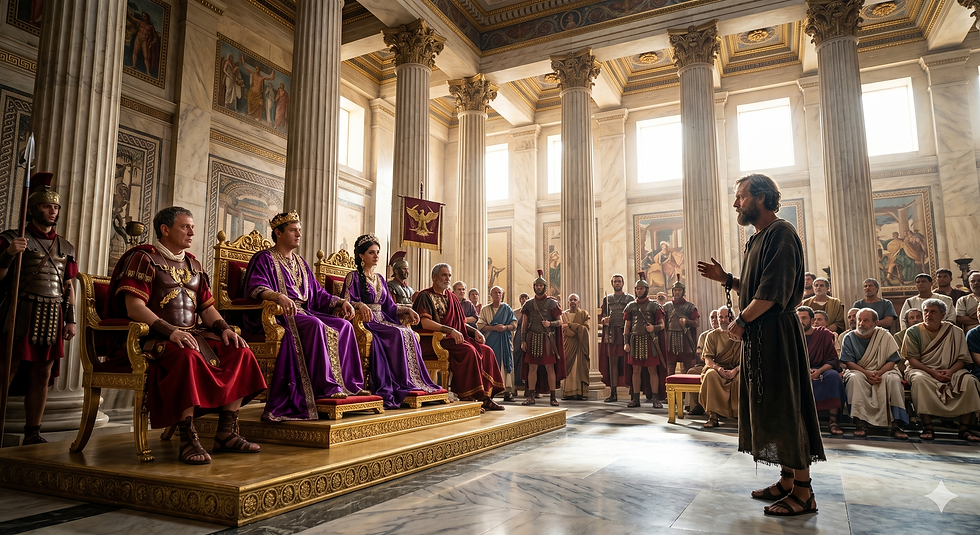
In Acts 10, we meet Cornelius, a Roman Centurion who is described as devout, God-fearing, and generous. While he is not Jewish, God sends an angel to tell him to seek out Peter.
Meanwhile, Peter is on a rooftop in Joppa when he receives a startling vision from heaven: a sheet filled with "unclean" animals is lowered, and a voice commands, "Rise, Peter; kill and eat" (Acts 10:13 ESV). Peter’s initial reaction is "By no means, Lord; for I have never eaten anything that is common or unclean" (Acts 10:14 ESV), but heaven replies: "What God has made clean, do not call common" (Acts 10:15 ESV).
The Breakthrough at Cornelius’ House
When Peter enters Cornelius’ home, he breaks a significant Jewish tradition that forbade associating with or visiting Gentiles. He realizes the vision wasn't just about food; it was about people. As Peter preaches, the Holy Spirit is poured out on the Gentiles before they are even baptized. This "Gentile Pentecost" proves that God shows no partiality and that all nations are now blessed through Christ.
Stoics, Martyrs, and an Iron Gate
The Gospel continues to spread to Antioch, where the disciples are first called Christians. Barnabas goes to Tarsus to find Paul, who was likely well-versed in the Stoic philosophy prevalent in that city. This is another reason why God used Saul. Both for his Jewish background but also his engagement to the Greek world.
However, opposition arises again. King Herod Agrippa I executes James the brother of John, making him the first apostle to be martyred. Herod then arrests Peter, intending to do the same.
In one of the most famous escapes in the Bible, an angel wakes Peter in his cell, his chains fall off, and they walk past the guards to the city’s iron gate, which "opened for them of its own accord"(Acts 12:10 ESV).
Who is John Mark?
John Mark is a fascinating figure whose story weaves through several key moments of the early church, and he is first introduced to us in the home of his mother, Mary, where believers had gathered to pray for Peter’s release. He was the cousin of Barnabas, the "Son of Encouragement," which likely explains why he was initially brought along as a companion for Paul and Barnabas on their first missionary journey. However, his early ministry was not without conflict, as he famously departed from the team during that trip, an event that some scholars believe was caused by homesickness or perhaps the intense spiritual warfare they encountered.
This departure led to a sharp disagreement between Paul and Barnabas later on, resulting in the two leaders parting ways for their second journey; Barnabas took Mark with him to Cyprus while Paul chose Silas as his new partner. Despite this rocky start, Mark’s story is ultimately one of restoration, as he eventually became a close and trusted disciple of Peter, who even refers to him affectionately as "Mark, my son" (1 Peter 5:13 ESV) in his writings. It is from this deep relationship with Peter that Mark is credited with writing the Gospel of Mark, effectively recording Peter’s eyewitness accounts of the life of Jesus. Beyond his gospel, tradition often links him to the young man who fled during Jesus’ arrest in the Garden of Gethsemane, and he remains a powerful example of how a setback in ministry does not mean the end of one's purpose in God's plan.
Looking Ahead: Clash of Cultures- Missionary Journeys
As we leave Week 5, we see a church that has become unstoppable. Peter has witnessed the iron gate of a prison open on its own accord , and more importantly, he has seen the iron gate of tradition swing wide to welcome the Gentiles into the family of God. We’ve seen that whether it’s raising the dead in Joppa or escaping a death sentence in Jerusalem, no barrier can hold back the move of the Spirit.
But the fire is about to spread even further. In our next study, I'll be covering the rest of chapter 9, chapter 10 and 11, and then through verse 2 of chapter 12. I've called this week, Clash of Cultures, as the narrative shifts gears. We move from believers being scattered by persecution to being intentionally sent by the Holy Spirit.
Final Thoughts
Peter told the household of Cornelius that God shows no partiality. This week, take a look at the "gates" in your own life. Are there people you’ve labeled as "unclean" or situations you’ve deemed "locked shut"?
If an iron gate can open on its own accord for Peter, God can open any door for you! Next time the missionary journeys begin!



Comments