Who Is the Holy Spirit? Understanding the Third Person of the Trinity
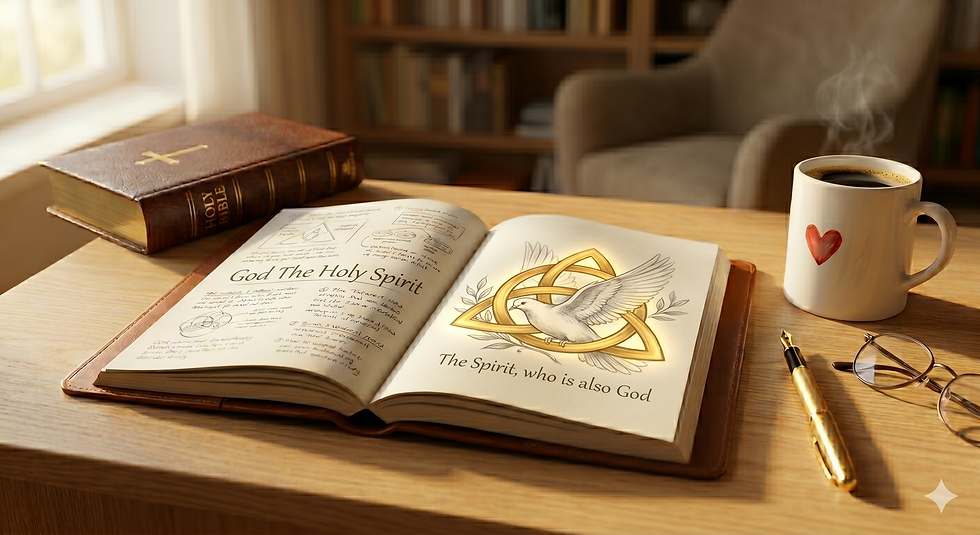
Over the last few weeks, we’ve walked through the mind-bending reality of the Trinity, looking closely at God the Father and God the Son. Today, we are rounding out our look at the distinct Persons of the Godhead by diving into God the Holy Spirit.
If we are being honest, the Holy Spirit is often the Person of the Trinity we find hardest to grasp. We can visualize the Father (even if metaphorically) and we can definitely visualize the Son because He became a man. But the Holy Spirit? He is often associated with symbols: a dove, a rushing wind, tongues of fire, or oil.
Because of this, many well-meaning Christians accidentally relegate the Holy Spirit to a cosmic "force". Like a spiritual electricity that God plugs us into when we need a power boost.
But the Bible tells a completely different story. The Holy Spirit isn't an it. He is a He. He is the third, co-equal, co-eternal Person of the Trinity.
Is the Holy Spirit a Person or a Force?
To be a "person" in the theological sense doesn't mean having flesh and bones; it means possessing personality. A force like electricity doesn't think, feel, or make choices. But the Holy Spirit does. Throughout scripture, we see that the Spirit has a mind, emotions, and a will:
He has a mind: He searches the deep things of God and teaches us (1 Corinthians 2:10-11).
He has a will: He distributes spiritual gifts to believers individually “as he wills” (1 Corinthians 12:11).
He has emotions: Ephesians 4:30 warns us not to “grieve the Holy Spirit of God.” You cannot grieve an impersonal force; you can only grieve a person who loves you.
He speaks, He guides, He comforts, and He convicts. He acts with intention. When you interact with the Holy Spirit, you are interacting with a Person.
The Deity of the Holy Spirit: Equal in Majesty
Just like the Father and the Son, the Holy Spirit is not a "lesser" version of God. He is fully Yahweh. He shares the exact same divine essence.
We see His distinct role perfectly displayed in how our salvation works: The Father planned it, the Son accomplished it on the cross, and the Holy Spirit applies it to our lives. He is the one who lives inside us, changing our desires, comforting our hurts, and helping us understand God's Word.
Key Bible Verses on the Holy Spirit's Divinity
When you want to study the deity and personhood of the Holy Spirit, keep these three vital scripture tools in your back pocket:
Acts 5:3-4 — “But Peter said, ‘Ananias, why has Satan filled your heart to lie to the Holy Spirit... You have not lied to man but to God.’”
Why it matters: In this famous (and intense) passage, Peter uses "lying to the Holy Spirit" and "lying to God" interchangeably. To lie to the Spirit is to lie to Yahweh Himself.
2 Corinthians 3:17 — “Now the Lord is the Spirit, and where the Spirit of the Lord is, there is freedom.”
Why it matters: Paul explicitly connects the Holy Spirit with the title "Lord" (the New Testament translation of Yahweh). He is sovereign, divine, and the source of true spiritual freedom.
John 14:16 — “And I will ask the Father, and he will give you another Helper, to be with you forever.”
Why it matters: When Jesus promises the Spirit, the Greek word He uses for "another" is allos, which means "another of the exact same kind." Jesus is saying, "I am leaving, but I am sending someone who is exactly like Me to be with you."
Why the Personality of the Holy Spirit Matters Daily
Why does the personal deity of the Holy Spirit matter to your regular, everyday life? Because it means God didn't just save you and leave you to figure out the Christian life on your own.
The Christian life isn't about pulling yourself up by your bootstraps; it’s about relying on a Person. The very same Holy Spirit who hovered over the waters at creation, who empowered Jesus during His earthly ministry, and who raised Him from the dead is the exact same Person who lives inside you right now. You have constant access to the presence, comfort, and power of God Himself, every single moment of the day.
So as we continue to lean into this mystery over the coming weeks, let's remember that our inability to fully explain God isn't a failure of faith. It's the beginning of wonder. Let's look at this beautiful, 1-in-3 reality not as a logic problem to master, but as a breathtaking glimpse into the infinite majesty of God.


Comments