History of the Nicene Creed: The Chaos and Conflict After Nicaea
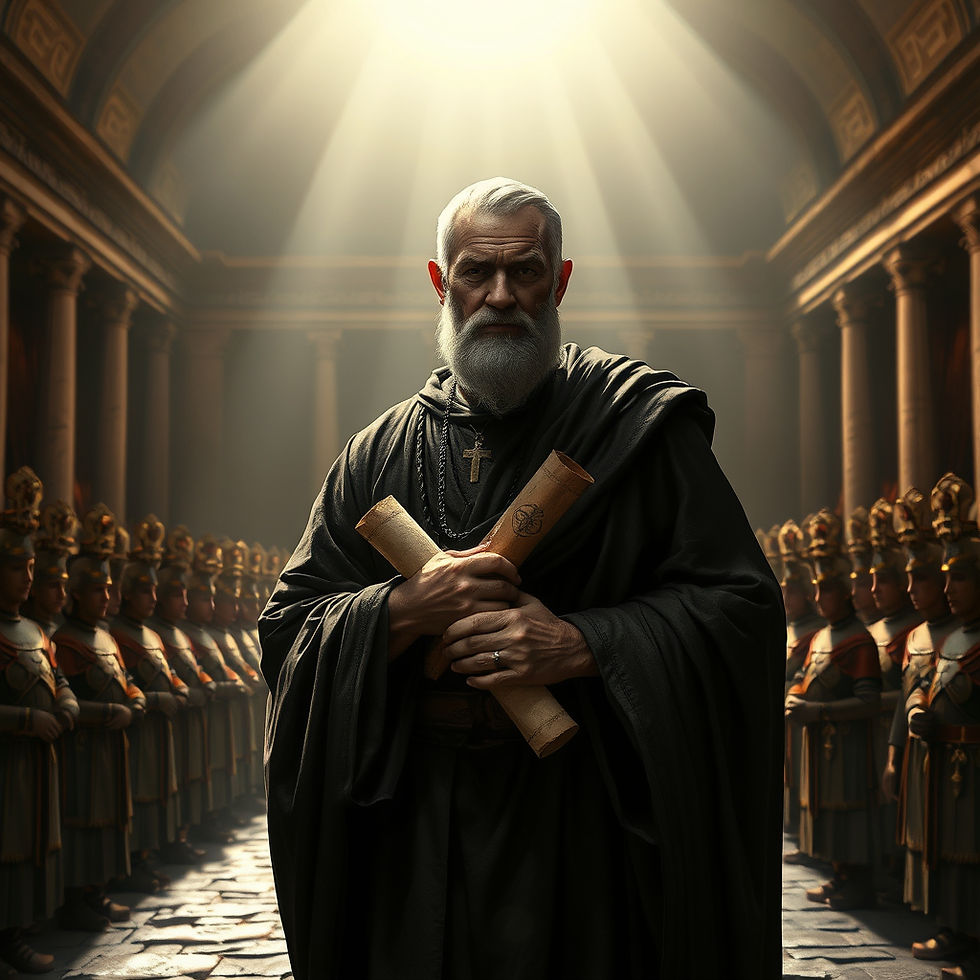
Last week, we busted the internet myth that the Council of Nicaea "invented" the Trinity in AD 325. We looked at the archaeological and scriptural receipts proving Christians already worshipped Jesus as God.
But if you think the story ends with the bishops packing up their bags and sailing home from Nicaea in perfect harmony, history has a wild surprise for you.
The decades after Nicaea were some of the most chaotic, dramatic, and dangerous years in Church history. The ink on the Nicene Creed wasn't even dry before political tides turned, and the true doctrine of the Trinity had to be fought for all over again. To understand how our modern Creed survived, we have to look at the timeline of the fifty years that followed the council.
The Council of Nicaea AD 325
The Creed is written to condemn Arianism, declaring Jesus is "of the same substance" as the Father.
The Era of Conflict AD 328–373
Arianism makes a political comeback. Athanasius is exiled 5 separate times for defending the Trinity.
Death of Athanasius AD 373
Athanasius passes away in exile, passing the theological torch to the Cappadocian Fathers.
The Council of Constantinople AD 381
Emperor Theodosius calls a new council, finalizing the Creed and fully declaring the deity of the Holy Spirit.
The Arian Coup: How the Trinity Was Outlawed
While orthodox bishops won the theological debate at Nicaea, the Arian faction won the political chess match afterward. Within a few short years, pro-Arian leaders managed to secure the ear of Emperor Constantine, convincing him to soften his stance.
When Constantine passed away, his son, Emperor Constantius II, took absolute control of the Eastern Empire. Constantius didn't just tolerate Arianism; he openly enforced it. This compromised version of Christianity (which claimed Jesus was a secondary, created being) aligned much more easily with the pagan and cult religions of the Roman Empire.
Imperial edicts were sent out, demanding that all bishops sign updated regional creeds. These new, politically motivated documents strategically stripped out the crucial Greek word homoousios (meaning "of the exact same substance") and replaced it with vague phrases suggesting Jesus was merely similar to the Father. Bishops who stood their ground and refused to compromise were stripped of their pulpits, branded as political rebels, and cast into exile.
Who Was Athanasius of Alexandria? (Athanasius Contra Mundum)
With the empire using its full legal and military weight to crush the Nicene faith, the defense of orthodox theology fell to a young deacon-turned-bishop named Athanasius of Alexandria.
Athanasius flatly refused to sign the Emperor's compromised creeds. Because of his stubborn obedience to Scripture, he became a primary target of the state. He was chased out of his church, hunted by imperial soldiers, and forced to flee into the harsh Egyptian desert to hide in caves and cells with monastic hermits. Over his lifetime, Athanasius was exiled five different times by four different Roman emperors, spending a staggering 17 years of his ministry as a wanted fugitive.
History rightly handed him the Latin nickname Athanasius contra mundum, which translates to "Athanasius against the world."
His resistance wasn't a petty argument over word choices; it was a battle for the Gospel itself. Athanasius famously argued that only the Creator can rescue the creation. If Jesus is a created being, then His death on the cross has no infinite value, He cannot save humanity from sin, and worshipping Him would be a form of idolatry.
One of the most cinematic moments of his life occurred during the Assault on the Church of Theonas in AD 356. Imperial troops surrounded his church during a late-night prayer service, bursting through the doors with drawn swords. Rather than fleeing in a panic, Athanasius calmly sat on his episcopal chair and commanded the congregation to sing Psalm 136: "For His mercy endures forever." As the soldiers rushed down the aisles, a wall of faithful churchgoers surrounded Athanasius, smuggling him out through a side door just as the altar was overrun.
Who Formulated the Trinity? Enter the Cappadocian Fathers
Athanasius fought valiantly for decades, but he passed away in AD 373—just a few years before his cause would be fully vindicated. He handed the theological mantle to a powerhouse trio of brilliant theologians from modern-day Turkey known historically as the Cappadocian Fathers.
This trio consisted of Basil the Great, his brother Gregory of Nyssa, and their close friend Gregory of Nazianzus. While Athanasius had spent his life defending the deity of the Son, the Cappadocian Fathers realized a new theological fire needed to be put out: a growing movement that denied the divinity of the Holy Spirit.
The Cappadocians provided the Church with the precise vocabulary it needed to clearly articulate the Trinity. They beautifully explained how God is one essence (ousia) existing eternally as three distinct persons (hypostaseis). They demonstrated from Scripture that the Holy Spirit is not an impersonal cosmic force, but an equal member of the Godhead who deserves identical worship.
The Council of Constantinople (AD 381) and the Holy Spirit
The tireless work of Athanasius and the Cappadocian Fathers finally bore fruit in AD 381. A new, orthodox Christian Emperor named Theodosius called for a gathering of leaders at the Council of Constantinople.
Fifty-six years after Nicaea, the bishops officially vindicated Athanasius' lifelong struggle and condemned Arianism once and for all. They took the original document from AD 325 and expanded its brief closing sentence ("And we believe in the Holy Spirit") into a grand, definitive statement on the third Person of the Trinity, worshiping Him as the "Lord and Giver of Life, who proceeds from the Father, who with the Father and the Son is worshiped and glorified."
This finished text gave us the expanded Nicene-Constantinopolitan Creed that thousands of local churches across the globe still stand and recite together every single Sunday.
The Athanasian Creed vs. The Nicene Creed
As the centuries rolled on, the Church realized it needed an even sharper, undeniable standard to protect everyday believers from getting confused by subtle theological twists. Though likely compiled a century after his death, the Church penned a magnificent document to honor the memory of the Trinity's greatest champion: The Athanasian Creed.
Unlike the shorter creeds, this document leaves absolutely zero room for logical loopholes or misunderstandings. It reads almost like a majestic poem, declaring the equal majesty of the Godhead:
"The Father is God, the Son is God, and the Holy Spirit is God. And yet they are not three Gods, but one God... So the Father is Lord, the Son is Lord, and the Holy Spirit is Lord. And yet they are not three Lords, but one Lord."
Is the Trinity Biblical and Historically Accurate?
Why does this chaotic history matter to your regular, everyday faith? Because it proves that the theological freedom you enjoy today—the ability to open your Bible and clearly see the beautiful, cooperative work of the Father, Son, and Holy Spirit—was bought with a massive price.
The orthodox doctrine of the Trinity didn't survive because it was easy or politically convenient; it survived because it was true. It was preserved by regular people who were willing to be hunted, exiled, and hated by the dominant culture so that the true Gospel wouldn't be lost to history.
Our faith is resilient. It has survived empires, political overthrows, and cultural shifts. When you worship the Triune God, you are standing on a historical foundation that the gates of hell tried to shake, but couldn't.
So as we continue to lean into this mystery over the coming weeks, let's remember that our inability to fully explain God isn't a failure of faith. It's the beginning of wonder. Let's look at this beautiful, 1-in-3 reality not as a logic problem to master, but as a breathtaking glimpse into the infinite majesty of God!


Comments