Bible Study: Acts Week 3 Chapters 6-8:3 Faith Under Fire
Updated: Jun 13
Welcome to Week 3 of our Bible Study journey through Acts. Last week, we witnessed the early church flourishing. This week, the atmosphere shifts as we move into Chapters 6 through 8:1-3. We transition from internal growth to external pressure in a study call Faith Under Fire.
Choosing the Seven: Leadership through Delegation
As the church grew, so did its logistical challenges. To ensure no one was overlooked, the apostles applied a principle seen as far back as Moses in Exodus: delegation. They chose seven men of good repute, full of the Spirit and of wisdom to handle daily needs so the apostles could remain focused on the Word. Among these seven was a man who would change history: Stephen.
The Face of an Angel, the Heart of a Lion
Stephen was on fire for the Lord, performing great wonders and signs. Naturally, this put him on the radar of the religious leaders. When they couldn't best his wisdom, they resorted to false accusations by claiming he blasphemed Moses and God.
Interestingly, the charges against Stephen mirrored the charges brought against Jesus in the Gospels:
The Claim: That he would destroy the Temple and change the customs delivered by Moses.
The Reality: While Stephen's face shone like an angel, he was preparing to give the ultimate defense of the faith.
A History Lesson with a "Come to Jesus" Finish
Stephen delivers a powerful defense that isn't just a rehearsal of history, but a targeted indictment of the religious leaders' recurring patterns. He demonstrates a profound knowledge of Israel’s history to show that God’s presence and plan were never limited to one building or one land.
Establishing Credentials: Stephen begins by recounting the history of important figures, locations, and divine actions to show he is not blaspheming God or Moses.
The Pattern of Rejection: He highlights how God’s chosen deliverers were consistently met with disobedience and rebellion by the people.
The Story of Joseph: He notes that while God was with Joseph and gave him wisdom, his own brothers, the very patriarchs of the tribes, were jealous of him.
The Story of Moses: He points out that God used Moses to deliver the people from slavery, yet they questioned his authority, asking, "Who made you ruler and judge over us?"(Acts 7:27, Exodus 2:14 ESV)
God Beyond the Temple: Stephen argues that God revealed Himself in places far beyond the Promised Land, challenging the idea that God is confined to the physical Temple.
The Climactic Indictment: He finishes by driving home the point that the religious leaders were acting just like their ancestors who persecuted the prophets. He concludes by stating that they had now betrayed and killed the very Messiah they had been praying for.
Resisting the Spirit: Stephen labels the leaders as "stiff-necked," accusing them of always resisting the Holy Spirit.
The First Martyr and the Witness in the Shadows
The reaction to Stephen’s speech was immediate and violent; the religious leaders were enraged and ground their teeth at him in rage. Yet, in the midst of this brewing storm, Stephen remained unshaken because he refused to focus on his surroundings. Instead, he gazed into heaven and saw the glory of God, with Jesus standing at the right hand of the Father. This moment serves as a powerful lesson for us today: while fear looks behind and worry looks around, faith looks up.
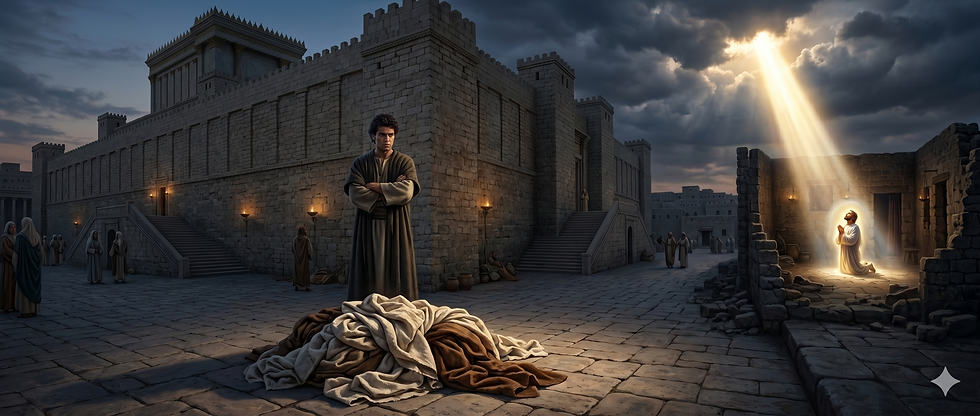
As the crowd dragged him out of the city to stone him, Stephen displayed a final, radical act of grace that mirrored Christ’s own crucifixion. Rather than carrying regret or unforgiveness into eternity, he cried out, “Lord, do not hold this sin against them” (Acts 7:60 ESV) Standing nearby, giving full approval to this execution, was a young man named Saul. At this stage of his life, Saul was a zealous Pharisee trained by the great Gamaliel, and he was actively guarding the robes of those casting the stones. While it seemed like a dark end for Stephen, this moment was actually the "BC" (Before Christ) chapter of Saul’s life, setting the stage for one of the greatest conversions in history.
Providence in the Persecution
Chapter 8 opens with a great persecution breaking out against the church in Jerusalem. To the human eye, this looks like a setback. However, through the lens of God's Providence, we see something else.
In Acts 1:8, Jesus commanded the disciples to be witnesses in Jerusalem, Judea, Samaria, and the ends of the earth. Up until this point, they had mostly stayed in Jerusalem. The persecution served as the "spark" that scattered the believers and the Gospel into the very regions Jesus had commanded them to reach.
Looking Ahead: The Gospel to the Gentiles
As we conclude our look at "Faith under Fire," the scene feels bittersweet. We leave Chapter 7 with the church mourning its first martyr, Stephen, and a young, zealous Pharisee named Saul standing over the tragedy with cold approval. To the human eye, it looks like a crushing defeat. But in the kingdom of God, what looks like a scattering is actually a sowing.
For week 4, I'll be covering the rest of chapter 8 and through verse 22 of chapter 9. I've called next week, The Gospel to the Gentiles, we will see exactly how God uses this "setback" to fulfill His promise from Acts 1:8. The wildfire of the Gospel is about to cross boundaries that no one thought possible.
Bible Study: Final Thought for the Week
Stephen’s last act was a prayer of forgiveness for his enemies. Little did he know that one of the men hearing that prayer, the very one approving and guarding the robes of the ones throwing the stones, would soon become the greatest missionary the world has ever known.
Never underestimate what God can do with your setbacks. Join us next week as the Way begins its journey to the ends of the earth!



Comments